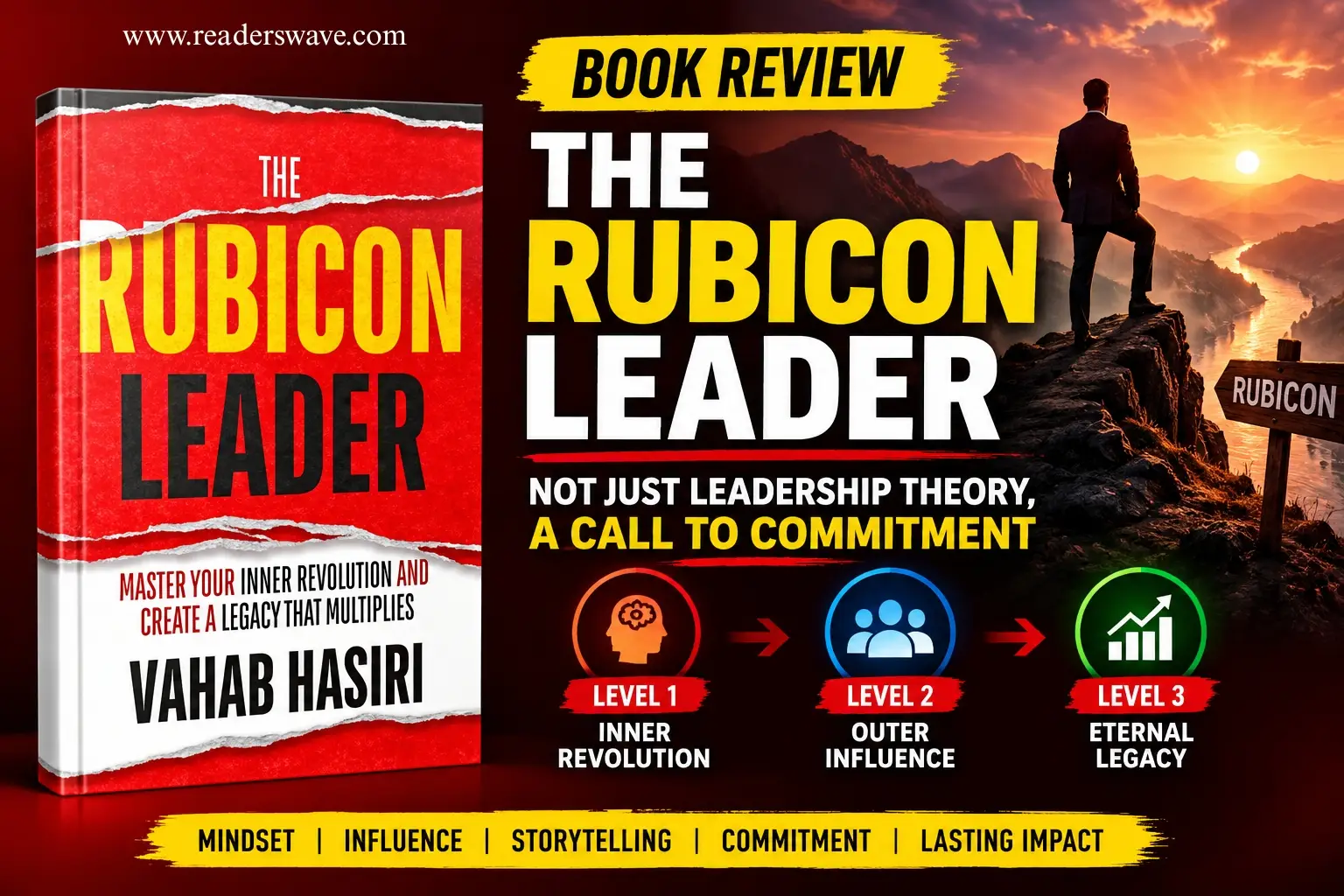
The Rubicon Leader by Wahab Hasiri
Introduction
“The Rubicon Leader” by Wahab Hasiri is not just another leadership book that talks about communication, management or teamwork. The book takes a more psychological and personal approach to leadership. It starts with a powerful idea – that every person has a “rubicon” to cross.
The Rubicon is the point where you stop living with a retreat option and make a deep commitment to becoming a different version of yourself. The author uses this metaphor to explain that true leadership does not begin when you get a title, promotion or authority. It begins when you decide to take complete ownership of your direction.
What I found most interesting is that the book first asks the reader to lead himself before trying to lead others. This makes the book more about inner transformation than traditional leadership techniques.
Get your copy here: The Rubicon Leader by Vahab Hasiri
What the book is about
The central idea of “The Rubicon Leader” is commitment. The author presents leadership as a psychological shift – a moment when you decide that going back to your old life, old behaviours or old identity is no longer an option.
The book is structured around three levels.
Level 1 – The inner revolution focuses on the individual. Before you lead others, you need to understand your own identity, beliefs, habits and behaviours. The author argues that many people are not really trapped by their circumstances, they are trapped by the beliefs they have about themselves.
The book’s “Invisible Prison” idea is exceptionally strong. Statements like “it’s too late to change”, “I am not the type who takes risks”, or “people like me don’t do things like that” can sound like realistic observations. But the author shows them as prison walls created by repeated beliefs.
Level 2 – The second level, outer influence, moves from self-mastery to the art of influence, communication, persuasion and trust. This is where leadership becomes interpersonal.
Level 3 – The third level, internal legacy, takes the idea beyond personal success. It focuses on building systems, mentoring others and creating something that continues to create impact even after you are gone.
Get your copy here: The Rubicon Leader by Vahab Hasiri
What I learned from this book
The biggest lesson I take from this book is that leadership starts with self-leadership.
The book’s discussion about “The Inner Revolution” makes this point clear.
If you want to change others, build a company, lead a team or create a legacy, you first have to be willing to change yourself.
Another powerful idea is the difference between pain-driven and vision-driven transformation.
Pain-driven change happens when something breaks – health problems, relationship failure, job loss, financial crisis or some other major event. The person changes because they have no other choice.
Vision-driven change is different. It begins with the question, “What could I become if I changed now?” This idea is very relevant because it reminds us that we don’t need to wait for life to collapse before we start building a better life.
The author sums it up with a very strong contrast: “I can’t take this anymore” is a pain-driven transformation, while “I can’t waste this anymore” is vision-driven transformation.
Another lesson is that fear does not have to disappear before you act.
The book’s discussion or the comfort zone explains that failure can push people back into familiar patterns. Leaders are not necessarily people who feel no fear. They are people who push through fear instead of becoming obedient to it.
This is a very practical definition of courage.
The book also brings in the idea of a new identity. The author draws on the concept of fixed and growth mindset to explain how people can treat current limitations as their permanent identity.
The most important takeaway is that your past behavior does not have to become your future identity.
Get your copy here: The Rubicon Leader by Vahab Hasiri
The Art of Storytelling and Influence
One of the more interesting parts of this book is it’s focus on storytelling as a leadership tool.
The idea is simple: people don’t only remember information; they remember the meaning and emotion attached to it.
A strong leader, therefore, does not just give facts. They build a story around the facts. A good story creates context, emotional investment and a sense of direction.
The book’s framework of conflict, transformation and resolution explains why stories can move people more than raw information.
Influence, according to this perspective, is not about manipulation or pressure. It is about understanding what people value, building credibility, giving value first and speaking at the right time.
Get your copy here: The Rubicon Leader by Vahab Hasiri
Who should read this book
“The Rubicon Leader” is a good read for aspiring leaders who are still developing their leadership identity.
It can be useful for:
1. Early stage leaders and managers.
2. Entrepreneurs facing high-stakes decisions.
3. People struggling with indecision or self-doubt.
4. Professionals who want to break comfort-zone patterns.
5. Readers interested in mindset, personal transformation and leadership.
6. People who want to build long-term influence and legacy.
If you are looking for a leadership book that is more concerned with “How do I become the person who can lead?” than “How do I manage people?”, this book can be a meaningful read.
Get your copy here: The Rubicon Leader by Vahab Hasiri
Conclusion
The most powerful message of “The Rubicon Leader” is not about how to control others. It is about how to stop negotiating with your own potential.
The book asks a direct question: “What is your Rubicon?”
What is the decision you know you need to make? What is the old identity you need to leave behind? And what is the version of yourself that you are afraid to become?
The rubicon metaphor works because crossing the river is not about having complete certainty. It is about committing despite uncertainty.
And maybe the book’s most important lesson is this: “The life you want is on the other side of the version of yourself you are currently protecting.”
You don’t always need a crisis to change. Sometimes, you just need a decision.
And that is where a leadership journey really begins.
Get your copy here: The Rubicon Leader by Vahab Hasiri
For more Book Reviews, connect with me on Instagram: Readers.Wave | Karunesh Potdar